

It is 3 PM on the last Friday of the month. Your top rep just closed a decent deal, high-fived the desk next to them, and then quietly packed up their bag. They hit their target, unlocked their bonus, and are now officially coasting until the 1st.
Meanwhile, you are sitting in your office, staring at your revenue dashboard, realizing the team is still 15% short of the company's monthly goal.
This is the classic dilemma every sales leader faces. If you build a compensation model that pays too little, your best killers will walk across the street to your competitor. If you pay too much, finance is breathing down your neck because you are eating all the profit margin.
A commission plan is not about paying people. It is about shaping behavior.
In this article, we are going to look at how to find that sweet spot - a sales commission structure that keeps your team hungry, prevents end-of-month coasting, and actually makes sense for your bottom line.
The 3 Classic Sales Compensation Plans (And Why Most Fall Flat)
Before we get into the advanced stuff, let's look at the baseline options every sales manager considers.
- Base Salary Only: Safe. Predictable. And a fantastic way to guarantee your team clocks out at exactly 5:00 PM. Zero extra drive.
- Straight Commission (100% Variable): Pure eat-what-you-kill. It works great for absolute mercenaries, but it makes it nearly impossible to retain consistent talent when the market has a slow month.
- Base + Commission: The gold standard. It gives reps enough baseline security to pay their rent, but enough upside to hustle for a new car.
Obviously, not everyone on the floor gets the same deal. Your SDRs grinding out 100 cold calls a day need a different structure than your Enterprise AEs navigating six-month deal cycles. But for this article, we are focusing on the engine room: the Base + Commission model.
The Sweet Spot: Base + Tiered (Marginal) Commissions
This is where most teams get it wrong. They build a flat commission rate or, worse, a retroactive bonus.
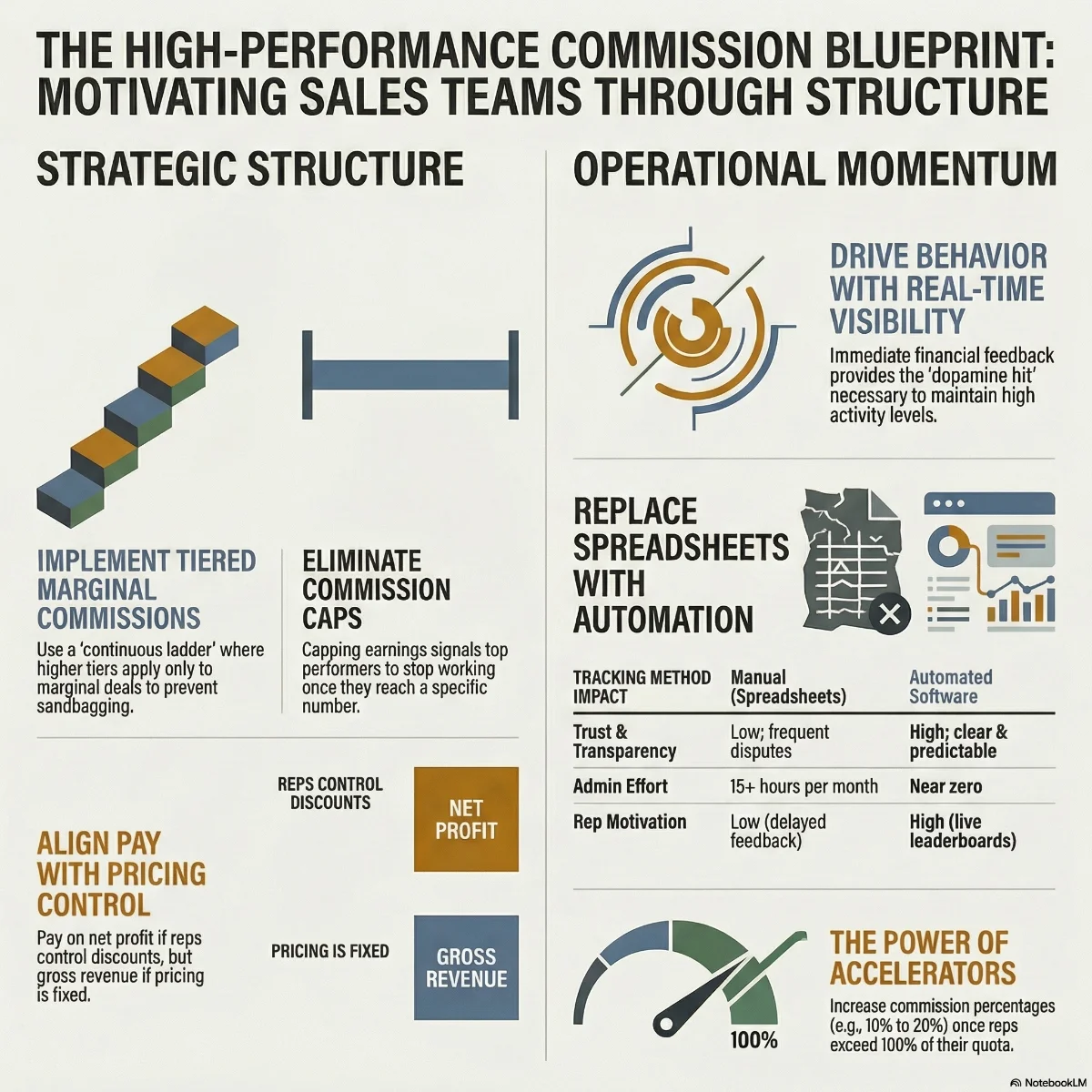
If a rep hits a quota and suddenly gets a retroactive bonus on all previous sales, you create a massive unnatural spike. They start hoarding deals, sandbagging the pipeline, and playing games with close dates to maximize their payout.
You want a tiered, marginal commission structure. Think of it like income tax brackets, but actually fun.
If your commission plan needs explaining every month, it is already broken.
It should be a simple, continuous ladder. You want them making 10% on the first $10k, and 15% on everything above $10k. There is never a single moment where the hustle stops making sense.
Real-World Example 1: High-Volume Financial Consulting
Let's say you run a team of 8 reps selling a financial consulting program for $5,000. It is a transactional sale. You need volume, and you need them on the phones all day.
- Tier 1 (Deals 1 to 5): 10% commission ($500 per deal).
- Tier 2 (Deals 6 to 10): 15% commission ($750 per deal) strictly on deals 6 through 10.
- Tier 3 (Deals 11+): 20% commission ($1,000 per deal) on everything from deal 11 onward.
If a rep is sitting at 5 deals on the 26th of the month, they are not slowing down. They know the next deal pays 50% more. They will make those extra calls.
Real-World Example 2: B2B SaaS Contracts
Now imagine a SaaS floor. Longer cycles, heavier pressure. Your AE is selling annual contracts at $12,000 ARR with a monthly quota of $50,000.
- Up to Quota (0% to 100%): 10% commission.
- Overachievement (101% to 150%): 15% accelerator on the overage.
- Top Tier (150%+): 20% accelerator.
Why does this work? The company safely covers its baseline operational costs first. Once the rep clears quota, they are bringing in highly profitable revenue, so you reward them heavily to keep the momentum going.
The Invisible Killer: How You Track Commissions
So, you built a killer, tiered sales compensation plan. Everyone is fired up. Then the end of the month hits.
Finance teams spend 15+ hours per month on commission spreadsheets. You export deals, clean the data manually, build formulas in Excel, and double-check everything. Every. Single. Month.
At first, it feels manageable. But then someone asks: "Wait, was this deal included?". Suddenly your simple spreadsheet becomes a detective story.
The real issue isn't the time. It is that trust slowly erodes. When commissions aren't 100% transparent, sales reps start to question the numbers. And once that doubt creeps in, every payout becomes a conversation.
Even worse? If a rep doesn't know what they are earning in real time, they slow down.
Spreadsheets vs. Commission Automation
You don't need better spreadsheets. You need to stop using spreadsheets for this altogether. Small mistakes become expensive. You are either overpaying or underpaying.
The shift that changes everything is automating the process. Tools that handle commission tracking give you live dashboards and clear payouts. By combining this with a real-time leaderboard, you create visibility, competition, and momentum. And those three together? That's rocket fuel.
| Aspect | Excel / Manual Tracking | Automated Commission Software |
|---|---|---|
| Time spent | 15+ hours/month | Near zero |
| Accuracy | Prone to errors | Consistent & reliable |
| Transparency | Low (end-of-month only) | Real-time visibility |
| Trust with reps | Frequent disputes | Clear & predictable |
| Motivation | None | Leaderboards & live tracking |
Final Thoughts: Stop Guessing, Start Scaling
A great sales commission structure aligns your reps' bank accounts with your company's growth goals. But if you are managing it in a fragile Excel file, you are stepping on your own oxygen hose.
Remove the friction. Give your team absolute clarity on what they are earning, and watch how fast their behavior changes. If you are ready to ditch the end-of-month chaos, commission automation is the exact upgrade your sales floor needs.
FAQ: Real Questions from Sales Leaders
Why do reps lose motivation mid-month?
Because they don't have real-time visibility. If they have to wait 30 days to see the financial impact of a closed deal, the dopamine hit is gone. The faster the feedback loop, the stronger the drive.
What is the biggest mistake in commission structures?
Caps. Capping commissions tells your best reps to stop working once they hit a certain number. If the deal is profitable for the company, you should always want them selling more.
Should I pay commissions on gross revenue or net profit?
It depends on your rep's control over pricing. If they can offer heavy discounts, pay on profit margin to protect the business. If pricing is fixed and controlled by leadership, paying on gross revenue is simpler and keeps reps focused purely on volume.