

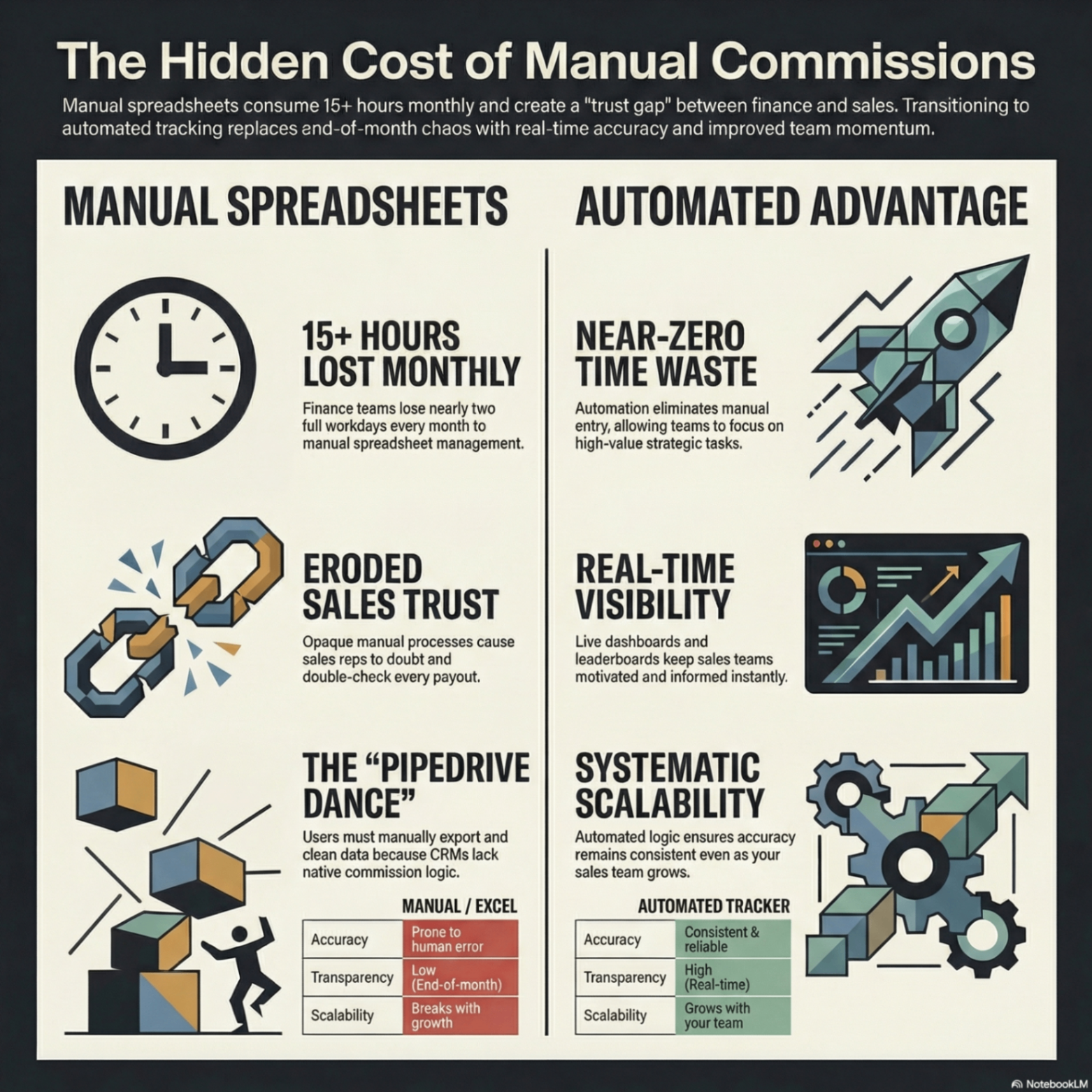
Finance teams spend 15+ hours per month on commission spreadsheets. Sounds annoying, right? But the real problem isn’t the time. It’s everything that comes with it.
Because let’s be honest for a second - this isn’t just about “doing some Excel work.” This is about end-of-month stress, awkward conversations with sales reps, and that constant feeling of “I hope this calculation is actually correct.”
It Always Starts the Same Way
At first, it feels manageable.
You export deals from Pipedrive. You open Excel. You build a “quick” formula.
And for a moment - it works.
Until it doesn’t.
Because then someone asks:
- “Wait, was this deal included?”
- “Why is my commission lower this month?”
- “Did we calculate this based on gross or net?”
And suddenly your “simple spreadsheet” becomes a detective story.
The Real Cost (That No One Talks About)
1. Time is just the surface
Yes, 15+ hours a month is a lot. But it’s not just time - it’s interrupted time.
You’re not calmly working through a process. You’re switching tabs, checking numbers, answering Slack messages, fixing errors.
It’s messy. It drains energy.
2. Trust slowly erodes
This one hurts the most.
When commissions aren’t 100% transparent, sales reps start to question the numbers.
Not because they don’t trust you - but because they don’t trust the process.
And once that doubt creeps in, every payout becomes a conversation.
3. Small mistakes become expensive
One missed deal. One wrong percentage. One outdated formula.
And now you’re either overpaying or underpaying.
Both are bad. One costs money. The other costs relationships.
4. It kills momentum
Sales teams run on motivation.
But if a rep doesn’t know what they’re earning in real time?
They slow down.
No leaderboard. No visibility. No excitement.
Just… waiting for the end of the month.
Excel vs. Automation - The Honest Comparison
| Aspect | Excel / Manual | Automated (Commission Tracker) |
|---|---|---|
| Time spent | 15+ hours/month | Near zero |
| Accuracy | Prone to errors | Consistent & reliable |
| Transparency | Low (end-of-month only) | Real-time visibility |
| Trust with reps | Frequent disputes | Clear & predictable |
| Scalability | Breaks with growth | Grows with your team |
| Motivation | None | Leaderboards & live tracking |
Why This Hits Pipedrive Teams Especially Hard
If you’re using Pipedrive, you already have clean deal data. That’s the good news.
The bad news?
Pipedrive wasn’t built to calculate commissions.
So teams end up doing this weird dance:
- Export deals
- Clean data manually
- Build formulas in Excel
- Double-check everything
Every. Single. Month.
This is exactly where tools like a commission tracker for Pipedrive CRM come in - not as a “nice to have,” but as something that removes the entire problem.
The Shift That Changes Everything
Here’s the mindset shift:
You don’t need better spreadsheets. You need to stop using spreadsheets for this altogether.
Because once commissions are automatic:
- No more end-of-month chaos
- No more “Did we miss something?”
- No more awkward conversations
Instead, you get:
- Live dashboards
- Clear payouts
- A team that actually trusts the numbers
And Honestly… It Just Feels Better
This part is hard to explain until you experience it.
But there’s something really satisfying about opening a dashboard and knowing:
“Everything is already calculated.”
No stress. No guessing. No late nights.
FAQ - Real Questions Teams Ask
Do most teams still calculate commissions manually?
Yes. Especially small to mid-sized teams. Many rely on Excel even when using advanced CRMs like Pipedrive.
Why is manual commission calculation risky?
Because it depends on human accuracy. One small mistake can lead to incorrect payouts and trust issues.
Can Pipedrive calculate commissions natively?
No. Pipedrive tracks deals very well, but commission logic usually requires external tools or manual work.
What’s the simplest way to automate commissions?
Using a dedicated commission tracker for Pipedrive CRM that connects directly to your deals and calculates everything in real time.
Final Thought
If you’re still calculating commissions in Excel, you’re not alone.
But you are paying for it - just not in a way that shows up on a spreadsheet.
You’re paying in time, stress, mistakes, and trust.
And once you see that clearly, the decision becomes pretty obvious.