

There are dozens of factors that influence your team’s close rate. Some are in your control, some aren’t. Some require massive time and budget. Others? Just a small shift in how you think as a sales leader.
In this article, we’re going to focus on one of those small shifts - the kind that can quietly push every rep on your team to their next level and help break both personal and team records.
And no - it’s not another “improve your pitch” guide.
The Usual Suspects: What We Already Try to Improve
When sales numbers aren’t where we want them to be, most teams instinctively look outward.
We invest in:
- Better customer journeys and automation flows
- Sales training and coaching
- CRM optimizations and cleaner pipelines
- New offers, discounts, and promotions
All of these are important. No question.
But notice something: they all focus on the customer.
How do we make the experience smoother, clearer, more persuasive?
That’s great - but it’s only half the picture.
The other half? Your salespeople.
Because at the end of the day, sales reps aren’t robots. They’re competitive, driven, emotional humans.
And if you tap into that correctly - you don’t get a 5% improvement.
You get a completely different level of performance.
Leaderboard: Why You Should Add One to Your Sales Team (Like, Tomorrow)
A sales leaderboard is exactly what it sounds like - a real-time ranking of your team based on performance.
Revenue. Deals closed. Conversion rate. Whatever matters to your business.
Simple idea.
Massive impact.
What Happens When You Introduce a Leaderboard?
Something shifts.
Suddenly:
- Reps check their numbers more often
- Top performers push harder to stay on top
- Mid performers see what’s possible - and start chasing it
- Even weaker reps become more aware of where they stand
This isn’t about pressure.
It’s about visibility + competition + momentum.
And those three together? That’s rocket fuel.
“But Won’t It Hurt Team Spirit?”
This is the most common concern from sales managers.
“Won’t this create too much competition?” “Won’t people stop helping each other?”
Valid concerns.
But in practice - when done right - the opposite happens.
The key is how you frame it:
- Celebrate wins publicly
- Highlight improvement, not just top spots
- Mix personal and team-based goals
Done right, a leaderboard doesn’t kill collaboration - it energizes the entire team.
The Psychology Behind It (And Why It Works So Well)
There’s a reason this works - and it’s not just “sales culture.”
Research in behavioral psychology shows that visible progress, competition, and recognition significantly increase motivation and performance.
One well-known concept comes from goal-setting theory (Locke & Latham), which shows that clear, measurable goals combined with feedback lead to higher performance.
Add a leaderboard on top of that - and now you’ve added:
- Social comparison
- Status
- Immediate feedback loops
In simple terms:
More dopamine → more action → more results.
What Should You Actually Track on Your Leaderboard?
This is where most teams either overcomplicate… or miss the point completely.
You want a mix of:
Individual Metrics
- Revenue closed
- Number of deals
- Close rate
- Average deal size
Team Metrics
- Total team revenue
- Progress toward monthly goal
- Collective close rate
The goal is to create a system where:
Everyone has something to chase.
Top performers fight for #1. Others fight to improve their position.
The Most Important Metric Almost Everyone Ignores
If I had to choose just ONE metric for a leaderboard?
Run Rate.
What is Run Rate?
Run rate answers a simple question:
“At your current pace - where will you finish the month?”
Example:
- A rep closed $10,000 in the first 10 days
- Month has 30 days
- Run rate = $30,000 projected
Why It’s So Powerful
Because it turns performance into a live game.
Instead of waiting until the end of the month:
- Reps see where they’re heading right now
- They adjust behavior mid-month
- They push harder when they’re close to a milestone
It creates urgency without pressure.
And that’s a rare combination.
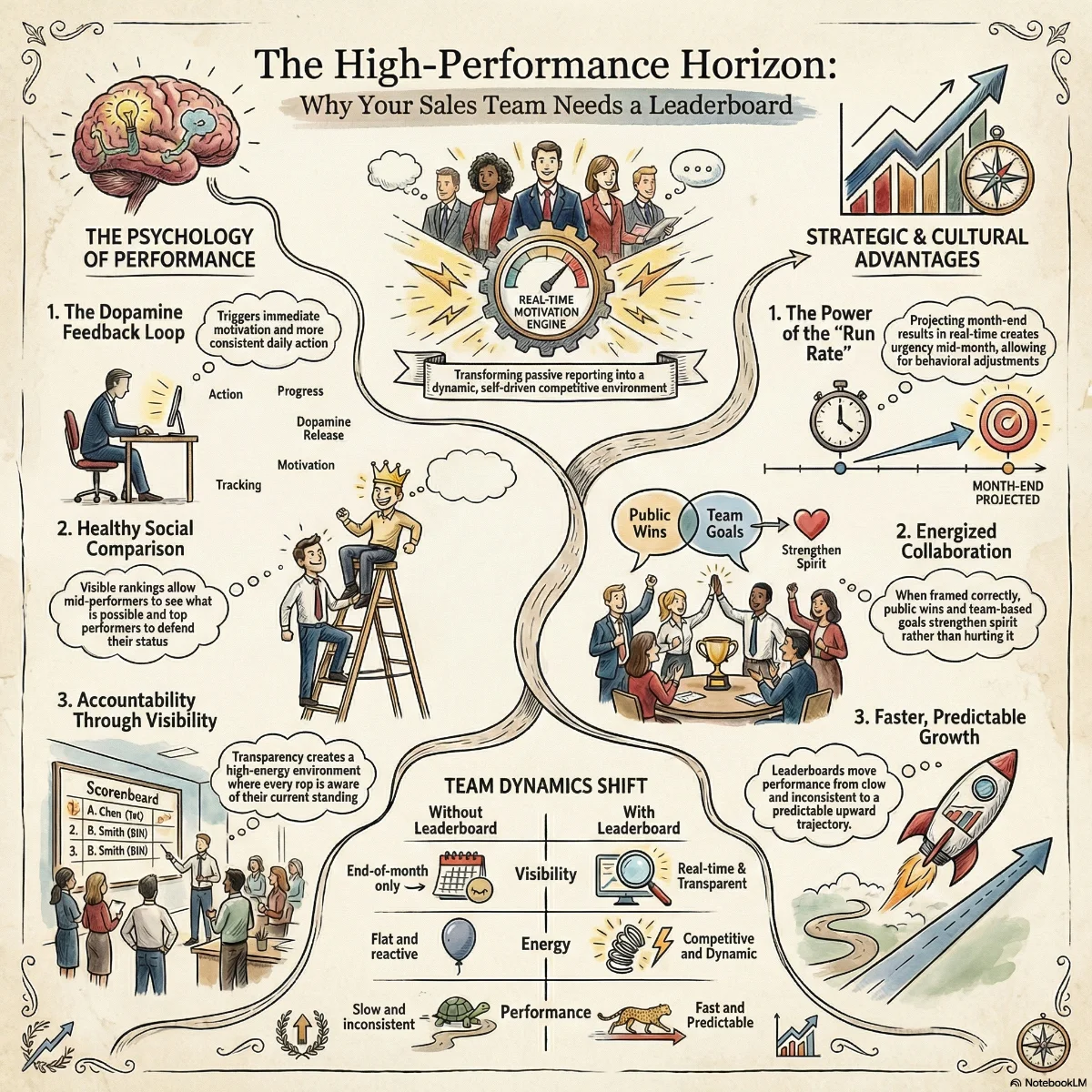
Sales Team With vs Without a Leaderboard
| Aspect | Without Leaderboard | With Leaderboard |
|---|---|---|
| Motivation | Low to medium, depends on personality | Consistently high across the team |
| Visibility | End-of-month only | Real-time, transparent |
| Accountability | Low | High (self-driven) |
| Energy | Flat | Competitive and dynamic |
| Performance Growth | Slow, inconsistent | Faster and more predictable |
How Do You Actually Build a Leaderboard?
There are 3 main approaches - and which one fits depends on your setup.
1. Inside Your CRM
Some CRMs offer dashboards.
They’re helpful - but usually limited:
- Not flexible enough
- No real gamification
- Hard to customize metrics
2. Google Sheets / Manual Setup
A lot of teams go this route.
Export data → build formulas → create charts.
It works… until it doesn’t.
Common issues:
- Breaks easily
- Not real-time
- Constant maintenance
- Data accuracy problems
Which ironically puts you right back into the spreadsheet mess.
3. Dedicated Tools (Recommended)
This is where tools like Delta Drive come in.
Instead of patching things together, you get:
- Real-time leaderboard
- Accurate commission calculations
- Clear visibility for reps and managers
- Built-in motivation mechanisms
No spreadsheets. No guesswork.
Just a system that pushes performance forward.
Final Thoughts
Most sales teams focus on improving the process.
Fewer focus on improving the people inside the process.
A leaderboard is one of the simplest ways to unlock that.
No huge budget. No long implementation.
Just a smarter way to channel the natural drive your team already has.
And once you see it working - you won’t go back.
FAQ
Does a leaderboard work for small teams?
Yes. In fact, it often works even better because visibility is higher and every position matters.
What if some reps feel uncomfortable with competition?
Start by focusing on personal improvement metrics, not just ranking. Over time, most reps naturally engage with the system.
How often should leaderboard data update?
Ideally in real-time or near real-time. The faster the feedback loop, the stronger the impact.
Can this replace sales coaching?
No - but it amplifies it. Coaching improves skills. Leaderboards improve behavior.