

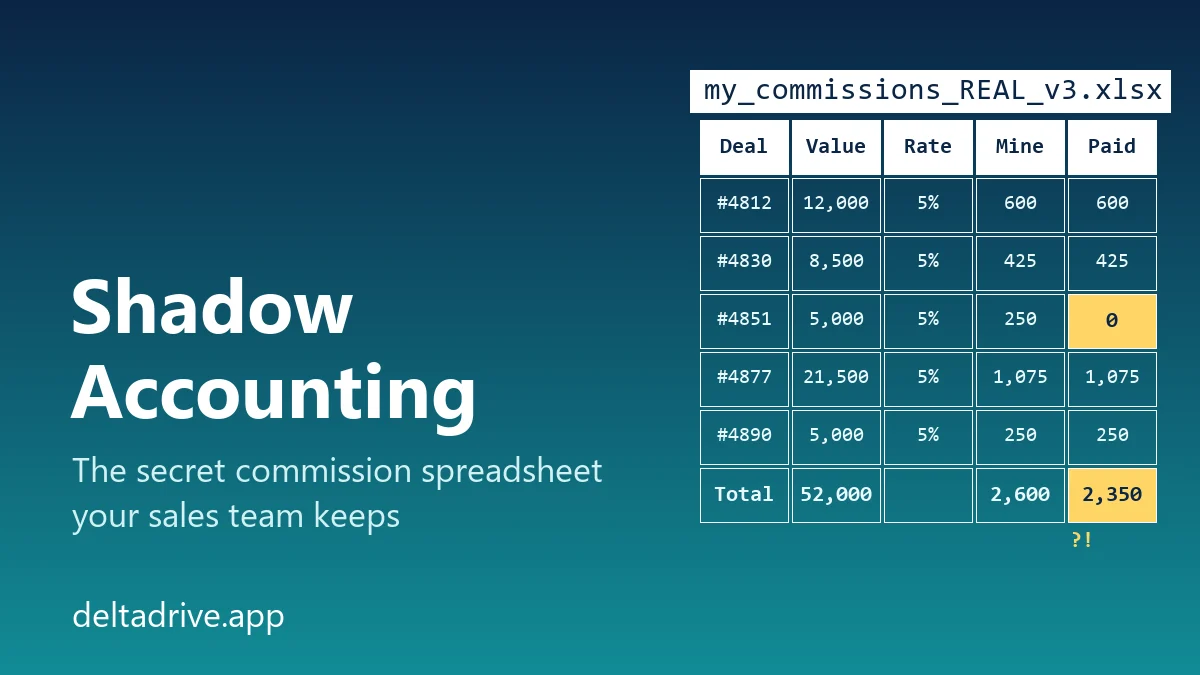
It's 11:40 at night. The house is quiet. Somewhere in a dark living room, a laptop opens and a file called my_commissions_REAL_v3.xlsx comes to life.
Not v1. Not v2. Those were before the tier change.
The owner of this file is your best rep. They're not stealing anything. They're not planning a mutiny. They're just checking that the deal they closed this afternoon is in there, with the right value, under the right month. Because last time, it wasn't.
Welcome to shadow accounting: the commission department your company never hired, staffed by every rep on your team, working unpaid overtime.
Key takeaways
- Shadow accounting is when reps keep their own private record of deals and commissions because they don't trust the official numbers.
- It doesn't mean your reps are paranoid. It means your commission process is invisible.
- It costs selling time, creates disputes on payday, and quietly tells you that trust is low.
- It goes away when reps can see their own numbers, with the same data and the same math, any time they want.
What is shadow accounting, exactly?
The short version: shadow accounting is a second, unofficial set of books. The company calculates commissions one way. Each rep calculates them again, their way, in their own file. On payday, the two get compared, and every difference becomes a conversation.
It's the sales version of checking the restaurant bill line by line. Nobody does that at a place they trust.
Meet your shadow accounting department
You may not have met them, but they're already on the team.
The Archivist
Screenshots every won deal in Pipedrive the moment it closes. Has a folder called "Evidence." Has never needed it. Will never delete it.
The Forensic Analyst
Rebuilt your tier structure in their own spreadsheet, with color coding and a formula you'd honestly like to borrow. Can tell you to the dollar how much the retroactive vs marginal question is worth to them. Has strong opinions about rounding.
The Diplomat
Never complains. Just has "a quick question" every month, around the 3rd, about one specific deal. It's always the same kind of question. It's always correct.
Finance (yes, them too)
Finance has its own commission sheet as well, because they don't fully trust the one sales sent over. So now there are three versions of the truth, and a meeting to decide which one is the real one.
Why it happens
Here's the uncomfortable part: shadow accounting is a reasonable response to an unreasonable process. Reps start keeping their own books when:
- They can't see the calculation. The number arrives on payday with no breakdown. "Trust me" is not a breakdown.
- They've been underpaid before. Once is enough. A single missed deal turns a rep into an archivist for life.
- The plan is too complicated to check in your head. Tiers, accelerators, targets, a bonus nobody remembers agreeing to.
- Data changes behind their back. A deal gets reassigned or its value edited after the export, and suddenly the CRM and the payout disagree. (This one is behind a lot of the most common commission mistakes.)
None of these are about bad reps. They're about a black box.
What it really costs
You won't find "shadow accounting" as a line in your budget, but you pay for it.
Selling time. Every hour a rep spends reconciling their sheet is an hour not spent on the phone. Want a rough number for your team? Multiply your number of reps by the time each one spends on their own commission tracking every month. If it's an hour each, a team of 8 just donated a full working day to bookkeeping.
Payday disputes. Two sets of numbers will always disagree somewhere. A deal moved between reps. A refund. A rounding choice. Each difference turns into a back-and-forth that can eat a manager's whole morning, and usually ends with both sides having been "right" by their own numbers.
Trust. This is the big one. A team that double-checks every payout is telling you, politely, that it doesn't trust the system. And reps who don't trust their pay don't stay forever.
Quiz: does your team run a shadow accounting department?
Give yourself a point for each one that sounds familiar:
- Reps ask about specific deals within two days of payday.
- At least one rep has asked you to "just send the breakdown."
- Someone on the team has a spreadsheet with "FINAL" in the file name. Twice.
- Commission questions arrive as screenshots.
- Finance and sales have each sent you a different total for the same month.
- You've said "I'll look into it" about commissions more than once this quarter.
- You are, right now, thinking of a specific person for item 3.
- 0 to 1: congratulations, your process is either transparent or your team has given up asking.
- 2 to 4: there's a shadow department, and it's growing.
- 5 to 7: the shadow department has a better system than you do. Consider hiring it.
How to shut it down (no raid required)
You can't ban the secret spreadsheet. You can make it pointless.
- Show the math, not just the number. Every rep should see which deals counted, the rate applied to each, and how the total was reached.
- Make it visible during the month. When reps can see their earnings and how far they are from the next tier on the 15th, questions get asked while they're still easy to fix.
- Use one source of data. Calculate from the CRM directly, not from an export that goes stale the moment it's downloaded.
- Write the plan in plain words. Rates, tiers, boundaries, what counts as a won deal, when the month closes. If it doesn't fit on one page, it's too complicated.
- Log every adjustment. Bonuses, clawbacks and splits get an amount, a reason and an approver. No more mystery numbers.
- Lock the month. Once approved, it doesn't change. Corrections go into next month, with a note.
Do these, and the Archivist will eventually stop taking screenshots. Probably. They'll keep the folder, though.
Where Delta Drive fits
We built Delta Drive to make the shadow department unemployed. It calculates commissions straight from your Pipedrive deals, using your own plan, and gives every rep a personal view of their deals, earnings and progress to the next tier during the month. Managers review, adjust with a reason, and lock the month. Finance gets the same report everyone else sees.
One set of numbers. Nobody has to keep a secret one.
FAQ
What is shadow accounting in sales?
It's when salespeople keep their own private records of deals and commissions because they don't trust the company's numbers. It's usually a spreadsheet each rep maintains alongside the CRM.
Is shadow accounting bad if the company's numbers are correct?
Yes. Even when payouts are right, the time reps spend checking them and the disputes over small differences cost money and trust. The fix is making the correct numbers visible.
How do I find out if my reps keep their own commission records?
Ask them, openly and without judgment. Or notice the pattern: detailed questions about specific deals right after payday usually come from someone comparing against their own list.
How do I stop shadow accounting?
Make the official numbers easy to check: show the calculation behind each payout, give reps visibility during the month, calculate from one source of CRM data, and log every adjustment with a reason.